Ask a safety review committee where its time actually goes, and the honest answer is rarely “reviewing the data.” It’s assembling the data: pulling listings from one system, cross-checking a signal against a source that lives somewhere else, confirming that a document everyone is looking at is actually the current version. The clinical judgment, once the committee has what it needs in front of it, is often the fast part. The slow part is everything that happens before the review can start.
Fragmentation Makes Reconciliation the Bottleneck
A safety review committee working across several disconnected systems, one for adverse event listings, another for lab data, a separate document store for prior meeting minutes and standard operating procedures, spends real time just confirming that what it is looking at is complete and current before it can trust any conclusion drawn from it. That reconciliation work is not a byproduct of a slow committee. It’s a structural consequence of asking people to assemble a single coherent picture from sources that were never designed to be viewed together.
The risk this creates is not usually that any one system’s data is wrong. It’s that stitching several systems together by hand introduces the chance of missing an update, working from a stale export, or reviewing a document that has since been superseded, none of which the committee would necessarily know about until it is too late to matter.
Centralizing the Workflow Is Not the Same as Centralizing the Data
The fix is not asking a trial to replace its safety database, its electronic data capture system, or any other system of record with something new. Those systems exist for good reasons and do their specific jobs well. The fix is giving the committee’s own workflow, task assignment, document distribution, meeting scheduling, and the record of what was reviewed and when, one governed home that sits alongside those systems rather than duplicating them.
That distinction matters because it changes what the committee is actually waiting on. Instead of waiting for someone to manually pull the latest listing from each source and assemble a packet, the committee works from a single, standing view of what is due for review, what has already been reviewed, and where each item stands. The underlying data still lives where it always did. What changes is how much manual reassembly stands between that data and the committee’s judgment.
The Manual Step Is Where Errors Actually Get Introduced
Every hand-off between systems, a listing exported here, a summary rebuilt there, is also a place where a small mistake can enter the record without anyone noticing at the time: a filter applied inconsistently, a row dropped during a copy, a document attached that turns out to be an earlier draft. None of that reflects carelessness on the part of the person doing the work. It reflects the simple fact that manual reassembly has more steps than an automated handoff does, and more steps means more chances for one of them to go slightly wrong. Reducing the number of manual steps between a data source and the committee’s review is not just a time saving; it is fewer places where an undetected error can quietly shape a safety decision.
What Speed Without a Shortcut Actually Looks Like
A faster safety review is only valuable if the process behind it can still show its work. A structured workflow that assigns review tasks automatically, distributes documents on a consistent path, and keeps a dashboard of open and closed items does more than save time: it produces a documented audit trail of who reviewed what and when as a byproduct of doing the work that way, rather than as a separate step assembled after the fact for an inspection. That is a meaningfully different kind of speed than simply asking people to work faster through the same fragmented process.
The Committee Should Not Be the One Doing the Assembly
There is a version of this problem that never gets fixed simply because it does not look broken from the outside: the committee meets, reviews thorough materials, and reaches sound decisions, while a coordinator or study team member spends hours before each meeting quietly reassembling those materials from separate sources. The committee’s own experience of the process can be perfectly smooth even while a significant amount of unrewarded, largely invisible labor sits just upstream of it. That labor does not show up in a meeting minutes document, and it rarely gets counted as part of the true cost of running safety review, which is exactly why it tends to persist long after everyone involved would agree, if asked directly, that it should not.
Naming that work and giving it a standard, automated home is what actually reduces the burden, rather than simply asking the same person to work faster through the same manual steps meeting after meeting.
A Governed Layer, Not Another System to Maintain
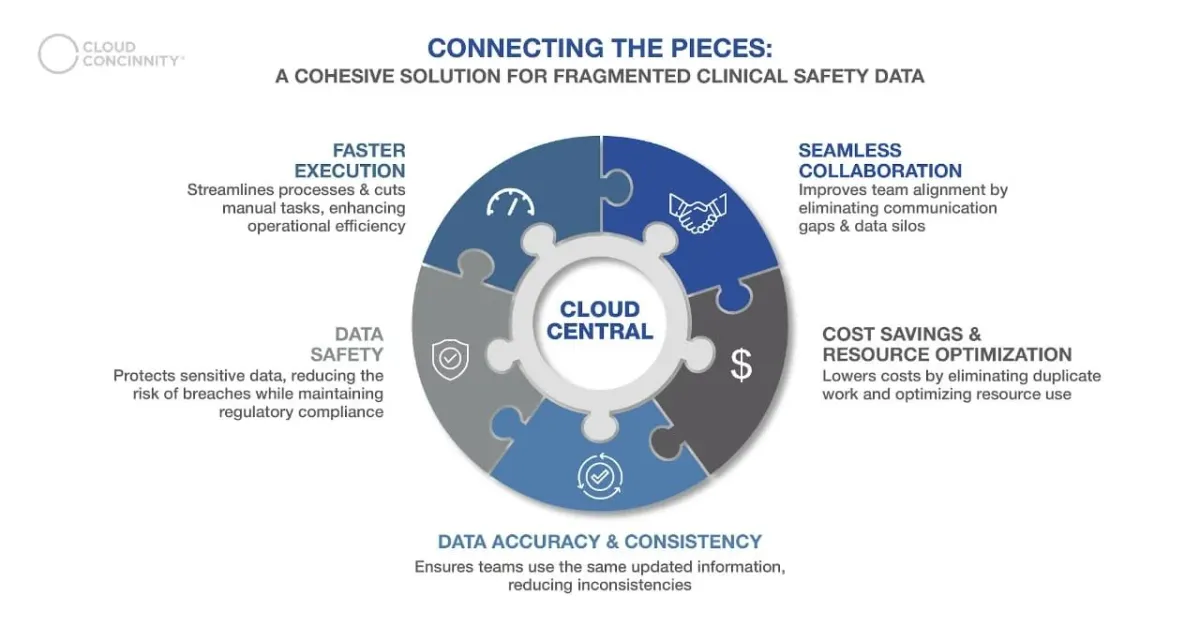
This is the practical shape of the execution layer a safety review committee benefits from: standardized task alerts so nothing sits unassigned, consistent document distribution so everyone is working from the same version, and a centralized view of study status that does not require compiling a separate update for the committee’s own use. None of it replaces the systems generating the underlying data. All of it removes the manual reconciliation that currently sits between that data and the review itself.
Safety review committees are not slow because the judgment is hard. They are slow when the judgment has to wait behind the manual work of proving the data in front of them is complete and current. Closing that gap is what actually shortens the path from data arriving to a documented decision, for sponsors and CROs alike, without asking anyone to trust a faster process any less than a slower one.